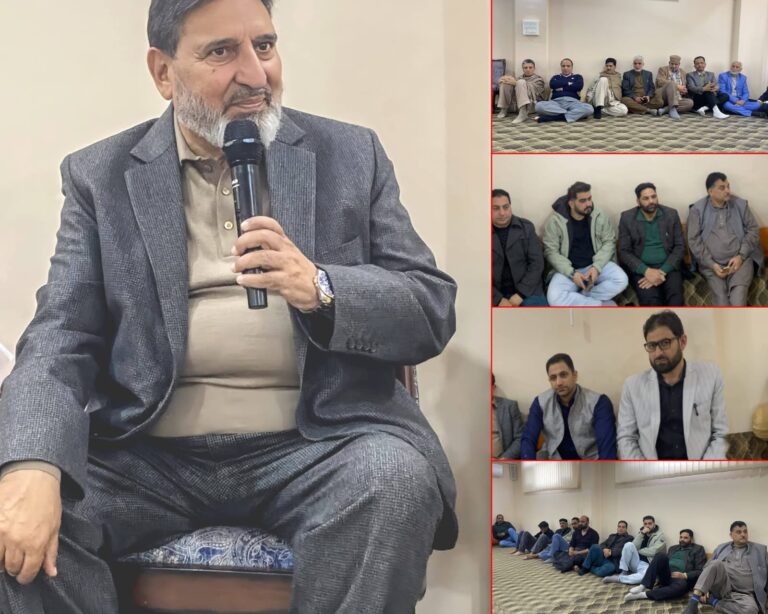
Social activist Javid Baig, along with members of different communities, visited Sangrampora Beerwa on the anniversary of the Kashmiri Hindu Pandit forced exodus day.

January 19, 2026: Sangrampora-Beerwah (District Budgam) – Noted Socio- Political activist Javed Ahmad Beigh, who has represented India at various sessions of United Nations Human Rights Council at Geneva, Switzlerland visited Sangarampora village located in Beerwah Tehsil of district Budgam along with a delegation of civil society of Beerwah drawn from different communities and interest groups to mark anniversary of “Kashmiri Hindu Pundit Forced Exodus Day”.
Taking to gathered media fraternity, Javed Beigh, who is an ardent advocate of return of Kashmiri Hindu Pandits said that 19th January remains a dark day etched in collective conscience of Kashmiri community as a day when Kashmir’s helpless Hindu minority began a forced mass exodus driven by threats, intimidatiob, rapes, extreme violence in which Kashmir’s majority community either remained silent or took active part in.
Javed Beigh added that the soil of Sangarampora in particular is solemn witness to one of the darkest chapters of contemporary history of Kashmir as it was here, during the turbulent and tragic years of the 1990s, eight innocent Kashmiri Hindu Pandits—mostly young—were brutally martyred solely because of their religion and faith. Their only “crime” was their religious identity.
Javed Beigh said that the blood stains of those 8 innocent Kashmiri Hindu Pandits remain ghastly blot on Kashmir’s majority community as well as on the collective conscience of humanity.
Javed Beigh reiterated that the forced exodus of Kashmiri Hindu Pandits was not a migration; it was a systematic, unwilling, forced and violent displacement under fear, intimidation, targeted killings, and terror, resulting in the tearing apart of Kashmir’s centuries-old Kashmiri Hindu-Muslim syncretic social, cultural, and civilizational fabric.
Javed Beigh added that on this day in 1990, the soul of Kashmir was wounded, as Kashmiri Hindu Pundits, an indigenous community—integral to its ethos, scholarship, pluralism, and shared heritage of Kashmir—was compelled to flee its ancestral homeland.
Javed Beigh also mentioned that among countless tragedies of that era, stands the martyrdom of Master Pandit Avtar Krishen Pandita Ji of Beerwah—a revered teacher, an enlightened mind, and one of the most respected public figures of our area. He was a symbol of Kashmir’s composite culture, knowledge, and moral authority. Javed Beigh added that Master Pandita’s assassination and the subsequent displacement of his family remain a stark reminder of how an ill conceived misadventure undertaken by Kashmir’s majority community with the backing of Pakistani gun silenced voices of wisdom and harmony.
Javed Beigh said that elders of our families and neighbourhoods recount those years as the most unfortunate and turbulent phase of our history. Javed Beigh added that during his today’s Sangrampora visit, a local elderly resident recalled the 1990s with visible pain, describing a time when fear overshadowed humanity and brotherhood was assaulted by radicalism. Javed Beigh further added that during his interaction with the elderly man,, he revisited that fateful day when the eight innocent Kashmiri Hindu Pandits were massacred in this very village—his eyes moist, his voice heavy, bearing testimony to wounds that time has not healed.
Javed Beigh further said that his today’s visit was not only about mourning, but it was also about moral clarity and collective commitment.
Javed Beigh told reportors that every one, who visited Sangrampora took a solemn pledge that they will collectively and unequivocally oppose religious radicalism, religious extremism, and terrorism in all its forms. They reaffirmed their shared resolve to work for the safe, dignified, and honourable return of Kashmiri Hindu Pandits to their homeland, not as a political slogan, but as a constitutional, human, and civilizational imperative.
Javed Beigh concluded that justice delayed must not become justice denied. He said that remembrance without resolve is hollow. As Kashmiris, as Indians, and as inheritors of a pluralistic legacy, it is the duty of Kashmir’s majority community to ensure that such darkness never revisits our land—and that the wounds of the past are healed through truth, accountability, reconciliation, and the restoration of trust. Javed Beigh finally concluded that Kashmir will be whole again only when its displaced children return home with dignity, security, and honour—and when extremism is defeated not by silence, but by collective conscience and courage.
About the Author